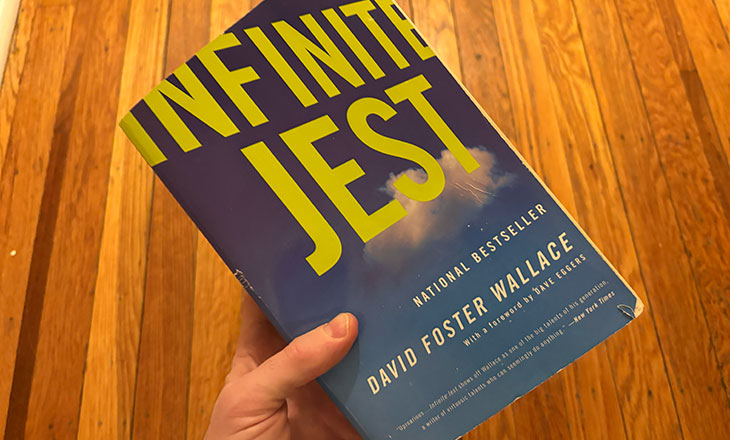
Late last fall, due to unemployment and a recent uptick in books completed1, I decided to finally attempt the twenty-first century white male’s white whale: Infinite Jest. Owned by many, read by few, it’s both a punchline and an aspiration.
I’d tried before but that first scene where Hal Incandenza sits in a University of Arizona (I think?) athletic office to discuss playing tennis always struck me as odd. Is Hal high? Is he autistic? What exactly is happening here? Do I want to spend a thousand pages reading this?
Pushing past the initial discomfort, I found myself enjoying it. I looked forward to sitting down with it. It’s odd but it’s not bad. It was becoming almost, dare I say, worth it.
But I just got past the halfway point of the novel, and the “infinite” part of the title is living up to its name. This is the part of any book where I start asking myself, “alright, what’s going on here?” And in between the detours and the footnotes and the interminable passages about these tennis academy kids, I couldn’t tell you what the hell this book is about or why I should keep reading it.
For example, around page 500 there is a passage in which a teenaged James Incandenza’s2 alcoholic father tries, angrily and obsessively, to solve the problem of a squeaky bed while James’s disaffected mother smokes silently in the corner of the bedroom.
This scene is emblematic of my experience with Jest so far. It’s nominally interesting, tangential, and it goes on for twelve fucking pages.3 Reading this passage was at least the tenth time during the reading of this book where I flipped pages forward looking for a chapter break or transition saying to myself, “Jesus Christ, how much longer is this going to go on?”4
I found this article by Mary K. Holland5that says that Wallace’s work was known for “audaciously6 reorienting fiction toward empathy, sincerity, and human connection after decades of (supposedly) bleak postmodern assertions that all had become nearly impossible.”
She then went on to say that “Wallace spoke and wrote movingly about our need to cultivate self-awareness in order to more fully see and respect others, and created formal methods that construct the reader-writer relationship with such piercing intimacy that his fans and critics feel they know and love him.”
A google search offers this elevator pitch: “… a sprawling, satirical7, and philosophical novel set in a near-future North America. It explores the dangers of extreme entertainment, the nature of addiction, and the human search for connection.”
That writing sounds delightful but, brother, ain’t none of that shit in Wallace’s writing. Jesus Christ.
Look, I’ve read A Supposedly Fun Thing I’ll Never Do Again, Brief Interviews with Hideous Men and now over half of Infinite Jest, which, on word count alone, is the length of two regular novels. I’m still waiting for the empathy, sincerity, and human connection.
Perhaps I’m a philistine. Maybe I am the product of the era that the brilliant DFW warned us about, and I have no attention span. Maybe I just don’t get it. Maybe I would, in fact, just be happy to put in a cartridge of a movie that will distract me literally to death.8
But, seriously, let’s talk about this empathy and human connection, shall we?
I just finished another passage in the book in which two addicts – Lenz and Green – are walking home from an A.A. meeting somewhere in Boston. Lenz wants to ditch Green because Lenz feels like killing an animal because that’s just something he does? And on the way, Lenz reveals that his own obese mother died after an accident in a bus port-a-potty in which her large ass got caught in an open lavatory window. That’s not what killed her, though. She got a huge settlement from the bus company and killed herself by indulging in the pastries cooked by the personal chef she was able to hire. Green’s mother on the other hand, died from shock at the springy snakes that shot forth from opening a joke gift of macadamia nuts on Christmas morning.
I suppose technically this book isn’t ironic but no way in fucking hell is it sincere. There’s an obvious word for what this book is: absurd.
Quebecois wheelchair assassins, an American secret agent in drag who is seducing an Arizona Cardinals punter while posing as a journalist in order to track down information about a movie made by his father – who killed himself by putting his head in a microwave – that is so entertaining that it irreversibly incapacitates anyone who watches it, a near future in which New York state and Quebec are now a gigantic garbage dump so toxic that there are rumors that they’re breeding mutants. That’s sincerity and human connection?
On top of all of that, it’s also just not particularly pleasant to read.
Reading Wallace, I feel like I’m in the mind of a neurodivergent9 PhD student who is so detached from humans that he can only describe the world in geometry. Christ, the way this guy talks about planes, angles, or vectors it’s about as poetic a slide rule.
From the aforementioned passage in the bedroom: “The mattress… now formed the hypotenuse or a right dihedral triangle whose legs were myself and the bed’s box spring. I remember visualizing and considering this triangle.”
Look, I get that he’s an extraordinarily smart guy.10 And I’ll forgive him for sending me to a dictionary every couple of pages. I get that it’s audacious.11 I just balk at the notion that this book is anything other than a smart guy trying to smart us all to death through the lens of things with which he is familiar: tennis, A.A., Boston, and Arizona.
Because I need breaks from it, I’ve read about eight different books since starting Jest. The Power of Regret, The Book of George, Sex and Rage, Beach Read, Life Without Children, Manhattan Beach, Glory Days, and 10:04. I just picked up The River is Waiting by Wally Lamb. In the fist chapter the narrator backs his car over one of his infant twins because he’s drunk on hundred proof Captain Morgan and Ativan and I already find it more fun to read than Jest.
I also have a few more general qualms with the book.
First, I do not care about the tennis academy. At all. And the goddamned tennis academy is about a third of the book. Does anything ever happen with these kids? Or do they just continue, like, playing tennis at a tennis academy in Massachusetts?
I also can’t believe that in my admittedly cursory research (googling) of the book I haven’t found anyone else who finds the description of Mario Incandenza downright cruel. Mario is Hal Incandenza’s older brother who is afflicted with birth defects, severe birth defects. He’s a homodont12 with arachnid arms, non-prehensile hands, and an abnormally large head. I’ll grant that Wallace trying to create a special character that is truly unique but with all these bizarre descriptions, Mario is literally not a homo sapiens. Why describe a character like this? It’s just… fucked up.
Additionally, there’s a character named Lyle who sits in the lotus position in the weight room and licks the sweat off of students for sustenance. I get that this book was before #metoo but was it before the concept of sexual predators?
At this point, you must be wondering why I don’t put it down. I will say that there are some genuinely enjoyable pieces throughout the book,13 placed just far enough apart that it keeps me from tossing this book out on the street.
But the real answer is pride. I want to finish what I start, and I don’t want to be a guy who couldn’t get through Infinite Jest. It also bothers me when I don’t get something that other people find brilliant. It makes me feel dumb, like the kid in high school English who rejects Shakespeare “because no one really talks like that.”
I also find it unlikely that I, Rob Penty, have seen through the bullshit to the core of this storied novel to find that it’s just not that great.
But I also think that when someone is considered brilliant, we afford them a lot of bullshit.14 Wallace is obviously highly intelligent, but his prose reads like a textbook or a master’s thesis and just because brilliant things are often difficult, it doesn’t necessarily mean that a difficult thing is brilliant.
I haven’t read a chapter in several weeks and I am not excited to pick the book back up. Maybe I’ve failed or maybe life is just too damn short.
See that? That was a moment of sincerity and admit it, you and I have connected, profoundly, on a human level.
And the footnotes aren’t fucking worth it.15
- Thirty-eight books in 2026, which a nice haul for me.
- James Incandenza, aka Himself, aka The Mad Stork, is Hal’s father.
- And Infinite Jest pages, due to their physical size, font size, and leading contain more text than a typical book’s pages.
- One such episode sticks out in my mind. There is a footnote in which there is a catalogue of James Incandenza’s films. Reading through that sparked some decidedly unsavory thoughts about Mr. Wallace.
- The main thrust of this article is Wallace’s history of misogyny, which I have not commented on in this piece, but I recommend you read the full article and then google “David Foster Wallace Mary Karr.” It’s not good.
- Q.v. note 11 sub
- I’m increasingly convinced that satire is a word used to describe writing that was intended by a smart person to be funny but never elicits an actual laugh.
- On the other hand, Wallace was apparently addicted to television, more than even I am.
- Had Wallace lived longer, I’m sure he would have been diagnosed with autism spectrum disorder. We’re talking about a grown man who wouldn’t do an interview during a book tour without a bandana on his head. And the elephant in the room: neurotypicals don’t write thousand-page novels. Go ahead think of one. Picture the author. They’re, shall we say, a little quirky aren’t they?
- But let’s be honest, he’s showing off. Why do you have to say “post prandial” when you mean “after dinner” or “dipsomaniac” when you mean “alcoholic.” And he really doesn’t need to say eschatological as much as he does, nor crepuscular, and his myriad cephalic descriptions are just weird.
- Long, audacious means that it is fucking long.
- Homodont – that means all of his teeth are the same, all bicuspids. When has there ever, in the history of human beings, been a homo sapiens homodont? Why would you describe someone that way? What the fuck are you doing, Wallace?
- If this entire book was just about Don Gately, I would be much happier.
- I am currently reading Shadow Ticket by the other patron saint of clever white guys Thomas Pynchon and I shit you not, the second half of this novel is fucking gibberish.
- Seriously, did you enjoy my cute little bit? At best it’s like kinda clever but not clever enough to really justify it, right?