When I was in college, during a weekly call with my parents, my dad interrupted our usual banter. Most of the time it was just them talking to me on separate phones, my mother on the wall-mounted kitchen phone, my father on the cordless in the living room. My mother would lob insults at my dad and I would tell them about school, neglecting to mention how much of my time was spent in a fraternity basement drinking beer from plastic cups.
“I’m sorry,” he said, “but I have something to tell you.”
My mom said, “Oh Bob, no.” It was standard dramatic Mom but the fact that she wanted to hide this from me foreshadowed how they would hide their declining health a decade later.
“No,” my dad said, “he needs to know. We had to put Spot to sleep.”
“Oh no, I’m so sorry, Dad.”
I’ll never forget what he said next.
“Well, she died with dignity in my arms.”
Spot was ostensibly the family dog but anyone could tell that she was my dad’s dog. He walked her. He took care of her. He loved her. But I’m the one who named her.
We got Spot as a puppy when I was in kindergarten after our poodle, Chi-chi (like “She-she” – what the hell do you expect her name to be? Spike? She was a poodle) passed away. Spot was a black and white lab and I knew immediately that I wanted to name her Spot. My mother groaned, “Really?”
“Yeah,” I said, “why?”
She sighed, “No reason. Spot’s a great name.” When you’re six, you’re immune to cliche but I could still tell that she was humoring me.
I wasn’t great to Spot. I remember whining when she wouldn’t leave me alone as I watched TV on the couch. My friend Jon saw how I treated her and said, “Dude, show your dog some love.” She was a sweet dog and all she wanted was some affection. For that she turned to my dad.
She was alive from kindergarten until sophomore year of college. Towards the end, she started getting growths on her upper legs and generally getting slower. She would eat grass in order to throw it back up. A veterinarian recently told me that dogs are actually quite good about end of life, both knowing when it is and preparing for it.
After Spot died, we got two young dogs from the same litter from our local rescue. Formerly named by little girls as Jasmine (from Aladdin) and Xena (i.e. The Warrior Princess), we rechristened them Jazz and Zoe.
Dad loved driving Jazz and Zoe to Highland Park. They would run freely and swim in the creek. They would shake off the water in the car and eventually the seats of the Ford Escort that he drove were caked with their hair.
He loved his dogs. I think that they were his only companions as he got older and my mother sank deeper into alcoholism. After he died, more than one neighbor recalled fondly the sight of my dad and his long stride walking a dog or two around our neighborhood.
I was with him when he died in a bed in a palliative care room, two days after having a stroke. Right after he passed away, I left his room and sat on the couch in the lounge area. I made some calls to tell some friends. When I was done I wanted to go back in and maybe spend some time with him.
But have you ever seen a dead body? It’s striking how different it is. Minutes before, my father was unconscious and motionless but still technically alive. Now he was dead and I knew it immediately. There was nothing there at all, just a body. I felt no allegiance to that body. I felt no comfort staying in the room with a corpse. He was gone and that was it.
My dad was methodical. He was on time. He woke up before my mother and me every morning. I don’t remember him ever being sick. He kept his bills and correspondence with overseas family filed in drawers. I never saw him drunk because he only ever drank two beers in a night, Genesee Lights from a can from a 24-pack purchased on sale by my mother at Topps, poured into the same glass beer mug. He read his historical biographies in the same chair every night. He sang in his church’s choir and was part of a men’s prayer group. He went to Rotary meetings and was active in the youth exchange program.
As I get older, I find myself turning into him. I share his independence and, like him, I join groups and communities and show up when I say I’m going to. I’ve still got a fair amount of my mom’s qualities, including an inappropriate sense of humor and a fondness for drinking to excess. My decision to get sober, however, was probably from my rational dad side. And also like my dad, I turned to a dog for companionship.
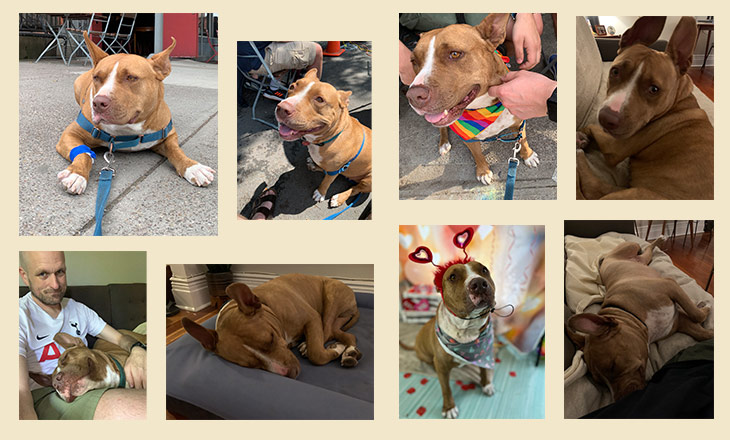
I admit I wasn’t really looking for that when I got Sapphire but that’s what happens with a dog. When I got Sapphire I just wanted a pet but she became my sidekick. I met more of my neighbors within a few months of having her than the previous decade alone.
She loved people. She loved to sit next to them for pets, to wiggle her butt when someone was close to petting her. She made people smile.
But they also told me the day that I got her that she had a kidney disease called Protein-Losing Nephropathy. I had always given her medication but I only looked it up later when she had started getting sick and the vet prescribed subcutaneous fluids that I would give her every day.
When I looked it up, it sounded dire. The life expectancy could be months. Somehow I thought, “Well, I’ve already had her for over a year. If it were serious, the vets would tell me and they love her. Everyone loves her.” I thought that Sapphire had some kind of special version.
She didn’t.
The first time I gave her subcutaneous fluids, she bounced back to her old self. Around three years of having her, she was slowing down and not eating her food but even more troubling, not eating treats or even a homemade pup cup (a Starbucks mug filled with whipped cream, also known as a puppuccino). And the treatment wasn’t working this time.
She was my buddy. I learned to love her more than I ever loved Spot. And she deserved all the love. Towards the end of my drinking, waking up at 3AM in a panic, wondering who I was becoming, I’d reach over to pet Sapphire and say, “Saphy, you and me, right, kiddo?”
Sapphire loved my couch. I used to joke that it was hers and she would just let me sit on it. Towards the end, though, I noticed that she mostly hung out on my bed. Looking back now I think it was a sign that she wanted to be closer to me. Sleeping in bed with me, her breathing was loud but I thought that was normal.
One morning I looked at my duvet cover and there were wine-colored stains all over it where Sapphire’s mouth had been.
I sent a picture to the vet and they told me to bring her in.
“How long has her breathing been this loud?” Aileen, one of the vet techs asked, unable to hide the alarm in her voice.
“I don’t know,” I said, “a couple of days?”
I had been preparing myself for the worst but I didn’t want to be over dramatic. Her ninth birthday was close. And I figured if things got bad, I could ask the vet and maybe get her one last send off with my soccer friends, people at my local bar The Gate, and people from the neighborhood. They could all say goodbye.
But as soon as she plopped down in the vet office, I knew that that wasn’t going to happen.
She did get goodbyes, though. All the vets and vet techs came in to say goodbye, many with tears in their eyes. Finally, the doctor came in with a Hershey bar for a final treat because why the hell not? But Sapphire didn’t want it. That’s when I knew that not only was it time but it was the right decision to put Sapphire down.
Ever since getting Sapphire, I started watching and interacting with all of the dog content on social media. One of the Instagram stories that I saw a few times was that so many people couldn’t be in the room with their dog when it was time to put them to sleep and how tragic it is when the dog looks around for their person at the end.
So, here’s the thing about my family: I always felt like we were different from other families. We got along and fought like a family but we also felt like three wiseass roommates who really didn’t buy into the whole picket fence thing, despite having a station wagon that had college stickers in the window, parked in our driveway on a street with an anglo-arboreal name (Oakdale Drive in my case). There weren’t any family lessons. No, “son, we need to talk,” or, “that’s not what a Penty does!” Despite all that, there was one clear lesson imparted to me by both of my parents: you don’t skip out on the hard stuff. If you wrong someone, you apologize in person. You stay at the bedside when someone is dying. And you sure as hell don’t leave the room when your dog has to be put down.
So, I knew, from my father’s example, his words ringing in my ears, that Sapphire was going to die with dignity in my arms.
I cradled her – this fifty pound pit bull – in my lap. They injected her with a syringe of white stuff to knock her out. Her jaw went slack and it almost felt like she was gone. Then they injected her with a syringe of pink stuff. They checked her pulse and she was dead.
The doctor asked, “Would you like some time with her?”
I thought of my dad’s body, lying in that bed in palliative care. “No,” I said. Sapphire was gone.
I walked home with her leash and her harness in my hands. I passed some people who knew her and loved her and saw me carrying it but they didn’t inquire and I didn’t volunteer it.
People talk about the sadness of coming home to an empty apartment after a pet dies. And I felt that. I felt it for so long.
It turns out “so long” is about a month and a half.
That’s when I decided to adopt Elby (formerly Lovebug). What had seemed like an eternity to me wasn’t that long at all considering people would often say, “Hi, Sapphire!” when they saw me walking with Elby. And then I’d have to break the news. And they were always sympathetic but at the end of the day Sapphire wasn’t their dog. After she died, people told me that I gave her a good life. All I can do is hope that that’s true.